
Heart
Pupil Premium and Recovery Grant Funding
Part A: Pupil Premium Strategy 2025-28
Reviewed date: December 2025
Statement of Intent
Our intention is that all pupils, irrespective of their background or the challenges they face, make good progress and attain well across the curriculum. This strategy runs from September 2025 to July 2028, but is reviewed regularly and at least yearly.
The focus of our pupil premium strategy is to support pupils experiencing disadvantage to achieve that goal, including progress for those who are already high attainers. We will consider the challenges faced by vulnerable pupils, such as those who have a social worker and young carers. The activity we have outlined in this statement is also intended to support their needs, regardless of whether they are experiencing disadvantage or not.
High-quality teaching is ar the heart of our approach, with a focus on areas in which disadvantaged pupils require the most support. This is proven to have the greatest impact on closing the disadvantage attainment gap and at the same time will benefit the non-disadvantaged pupils in our school. Implicit in the intended outcomes detailed below, is the intention that non-disadvantaged puils' attainment will be sustained and improved alongside progress for their disadvantaged peers.
Our approach will be responsive to common challenges and individual needs, rooted in robust diagnostic assessment, not assumptions about the impact of disadvantage. The approached we have adopted complement each other to help pupils excel. To ensure they are effective we will:
- ensure disadvantaged pupils are challenged in the work that they're set
- act early to intervene at the point need is identified
- adopt a whole school approach in which all staff take responsibility for disadvantaged pupils' outcomes and raise expectations of what they can achieve
- further develop out belonging and inclusion strategy to ensure all pupils, especially those experiencing disadvantage, feel celebrated and have clear purpose.
Challenges
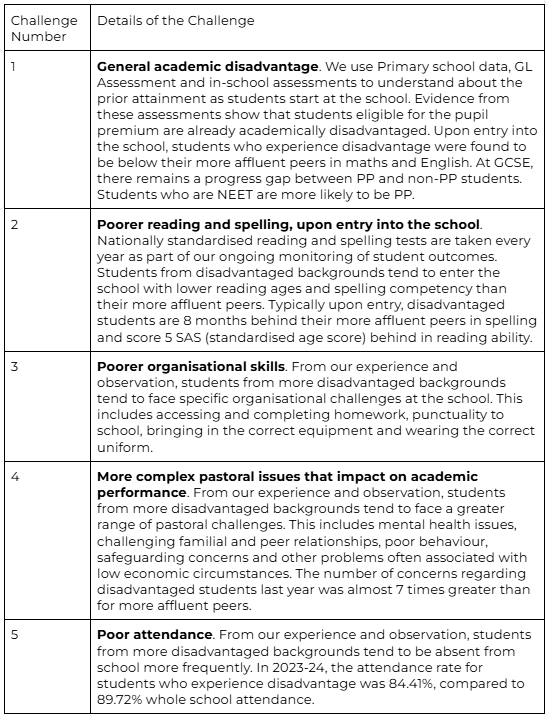
The table below outlines the key challenges to achievement that we have identified among our disadvantaged pupils.
Intended Outcomes
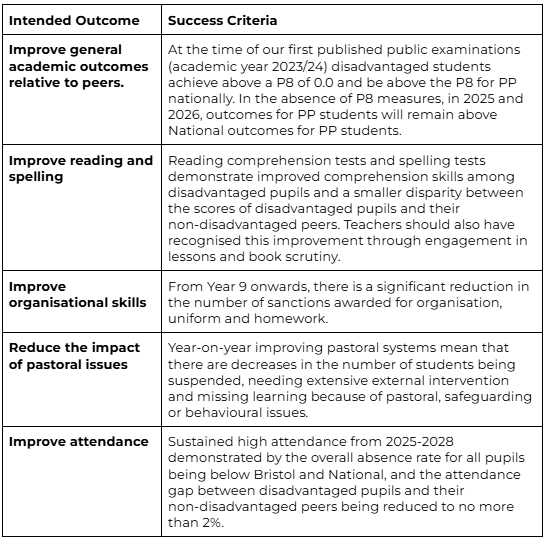
This explains the outcome we are aiming for by the end of our current strategy plan (2025-28), and how we will measure whether they have been achieved.
Activity in this academic year
This details how we intend to spend our pupil premium (and recovery premium funding) in the 2024/25 academic year to address the challenges listed above.
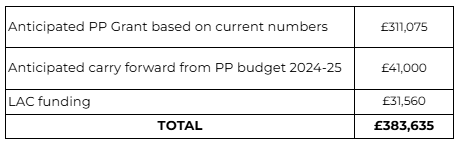
Predicted income: £383,635
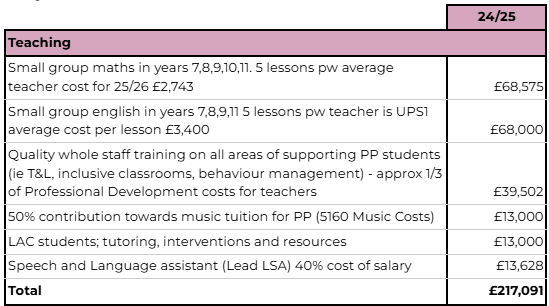
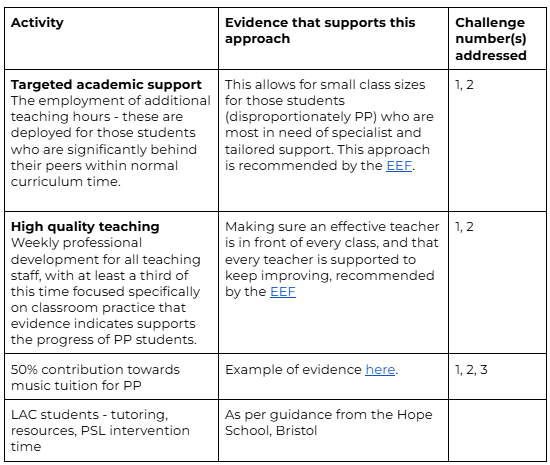
High Quality Teaching and Targeted academic support
Budget cost for the below: £217,091
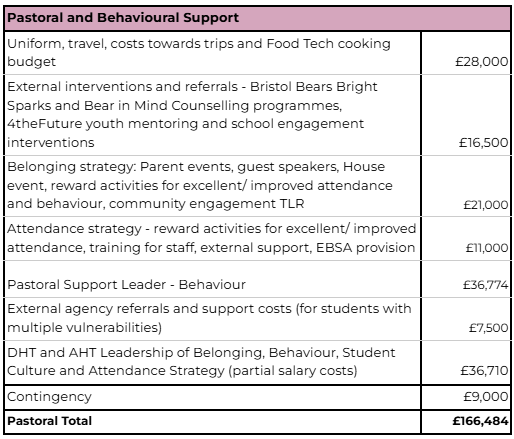
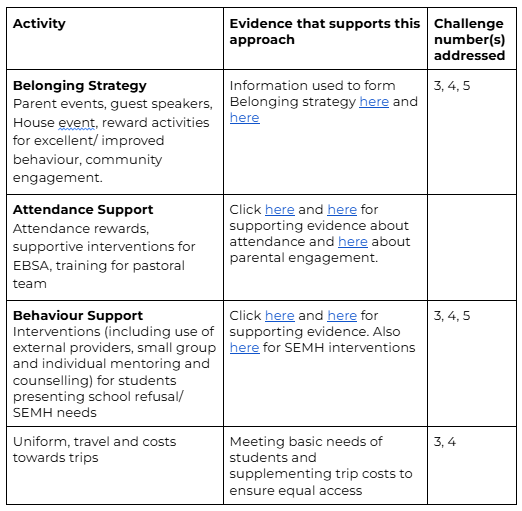
Wider barriers to learning
Budgeted cost: £256,705
Part B: Review of Outcomes in the Previous Academic Year (2024/25)
Positive Impact on Academic Outcomes
Y11 public examinations
We have two primary measures for student performance at CGSE. Attainment 8 measures the average grade achieved by students across their 8 strongest subjects. Progress 8 measures the average progress made by students across their 8 strongest subjects relative to their prior attainment. Below are our relative performance indicators.
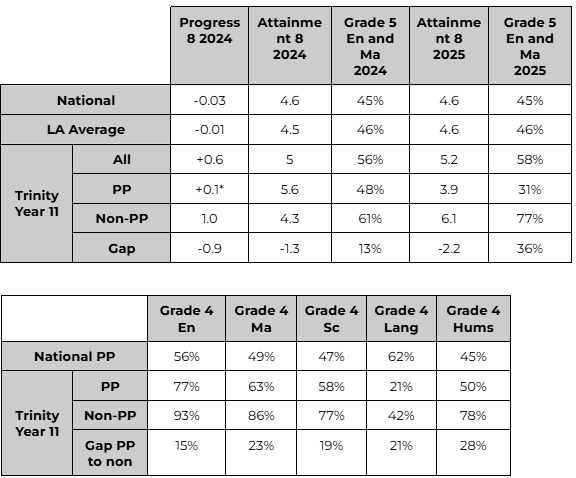
In English, Maths, Science and Humanities, Trinity PP students outperformed PP students nationally. However, the gap between our PP and non-PP students remains stubbornly large in all subjects.
*This indicates our PP students are making progress in line with all students in similar schools (PP and non-PP).
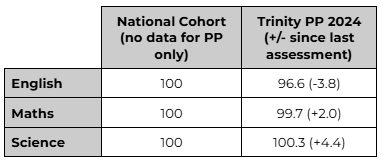
The nationally benchmarked test results, summarised below, also suggest that PP students are making more progress than the average student, nationally. The results alo suggest that PP students are, on average, outperforming the national cohort.
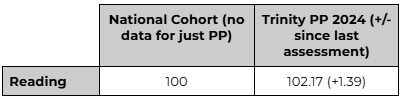
Improve reading, We measure this through nationally benchmarked reading tests, carried out annually. The table below shows a summary of these tests across all years. Results suggest that PP students are making more progress than the average student, nationally. The results also suggest that PP students are, on average, outperforming the national cohort.
Positive Impact on Pastoral Measures
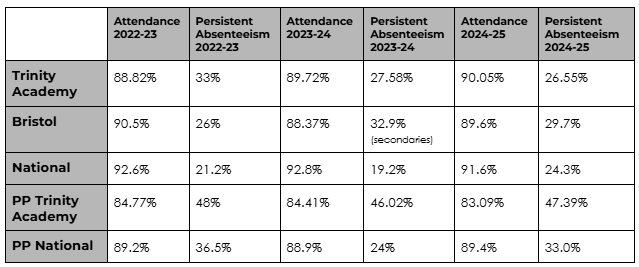
PP numbers 2023-24 33.5% at Trinity compared to 27.3% nationally, our PP cohort is above National average.
Attendance Improvements 2022-23 to 2023-24
As a result of pastoral intervention, funded by the Pupil Premium, we saw a reduction in persistent absenteeism for students who experience disadvantage between 2022-23 (48% PA) to 2023-24 (46% PA). The attendance for PP students 2023-24 fell by 0.3% from the year before, which is in line with a National drop in attendance for PP students of 0.3%. In 2024-25, out attendance for PP students remained stubbornly below national PP figures and persistent absenteeism remains above national figures. This continues to be a significant focus for us in 2025-26.
Behaviour Improvements 2022-23 to 2023-24
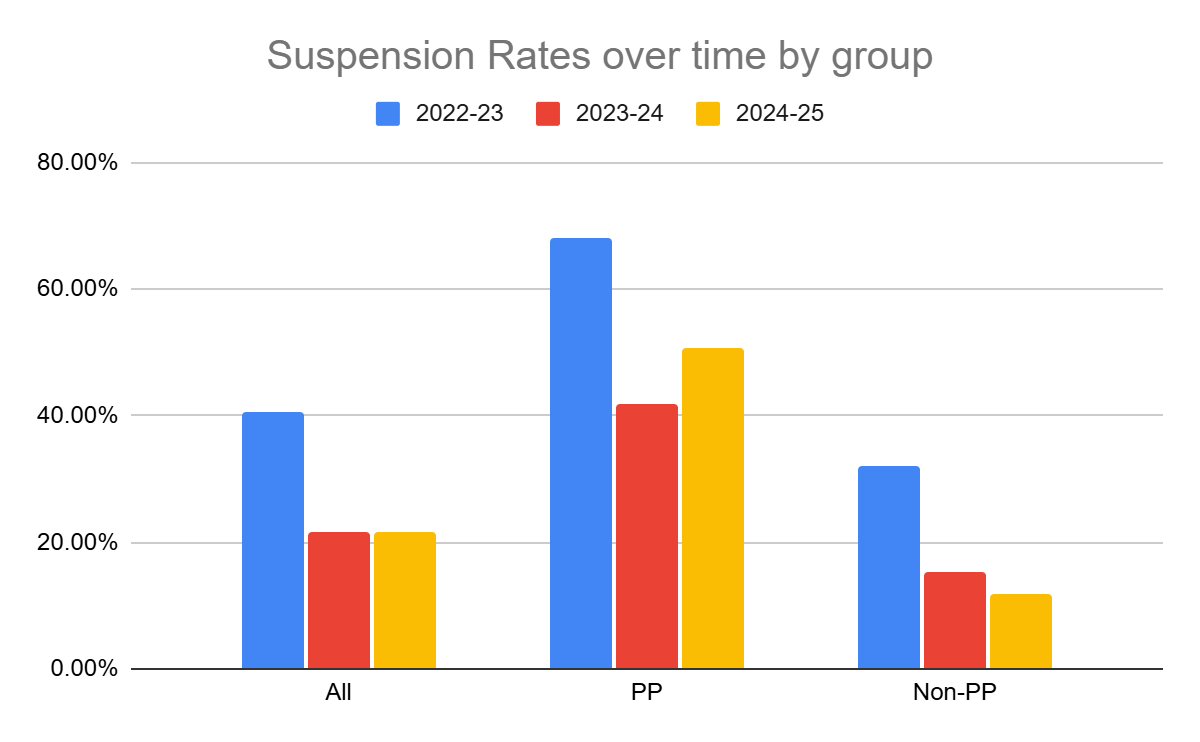
Suspension rates were halved for all students at Trinity Academy between 2022 and 2025, as demonstrated in the graph seen below.
There still remains a gap between the rates that PP and non-PP students are suspended, but this is closing:
- 2022-23 PP to non-PP gap 62.2%
- 2023-24 PP to non-PP gap was reduced to 31.4%
- 2024-25 PP to non-PP gap widened slightly to 38%, but is below 2022-23
Work continues to reduce the rate of suspensions for PP students, as per the pastoral plans detailed above.