

Head
Academic Curriculum
Our Curriculum Purpose
Our shared intent at Trinity Academy is to provide a curriculum that is highly academic and ambitious for all students, regardless of prior attainment, and that particularly prizes the performing arts and is reflective of our local community.
Each subject curriculum is planned by subject specialists with a strong understanding of the types of knowledge present in their subject. This knowledge can be the facts that students need to know, the procedures students need to learn or even how knowledge itself is created within a subject by specialists.
Why this Curriculum for our Students?
We are proud to serve a very diverse student community. Typically, students in Year 7 join us from over thirty different local primary schools and, as a result, experience different curricula and varying degrees of academic success. Almost half of our students live in areas of significant socioeconomic deprivation, whilst about a fifth live in areas of very high affluence. Finally, our student community is culturally and ethnically diverse, with around half of Trinity students coming from non-white backgrounds.
The school curriculum is designed with our diverse community in mind. We know students from such a range of primary schools are likely to join us with very different mental maps (or schema) of the world around them, because each primary school curriculum varies in scope and emphasis. To address this, all Year 7 and 8 students (Phase One) learn a common core academic curriculum consisting of facilitative subjects that provide a profound understanding of the world around them – art, English, humanities (history, geography and religion, ethics and philosophy), language (French or Spanish), maths, the performing arts (dance, drama, music), physical education and science. From Year 9, the curriculum expands to include more technical subjects – for example, design & technology, food technology and computing.
We also know that by the time students arrive at secondary school, those from disadvantaged backgrounds tend to have a more limited vocabulary, lower reading ages and fewer cultural experiences. We believe an academic curriculum – with an emphasis on the performing arts – is an effective way to counter this. Subject leaders select carefully the knowledge within their disciplines that profoundly explain the world around us (sometimes referred to as Powerful Knowledge), explicitly teach subject vocabulary and provide plenty of opportunities to read. Our emphasis on the performing arts and on co-curricular clubs also provides a wealth of cultural experiences that students may not have access to outside of school.
Finally, we are proud to serve a culturally diverse community and we want our curriculum to reflect and celebrate the rich diversity in culture of our local community. This, to a varying degree by subject, is reflected in the choice and sequence of knowledge in the curriculum. Parents have the right to withdraw their child from RE lessons.
How the Curriculum is Developed
Individual subject curricula are developed with the school's curriculum purpose in mind and our Trust's curriculum principles in mind. Curriculum leaders develop and refine their subject curriculum through a series of sequential steps, shown below.
- A clear purpose: Curriculum leaders design a curriculum with a purpose in mind that contributes towards the school’s broader curriculum purpose. Knowledge is selected carefully to allow students to develop a deeper understanding of the world around them.
- Knowledge as end points: Curriculum leaders specify knowledge as specific and granular end points. Teachers know the end points for every unit and lesson they teach.
- Sequencing of end points: Each subject curriculum is carefully sequenced so that students develop increasingly rich and complex knowledge. End points are ordered in a way that gives students the best opportunity to learn new things.
- Guided by cognitive science: Each subject curriculum is designed to help students remember what they are taught. This means that new material is taught and then revisited at later points in the curriculum. It also means that the volume of new material taught in any given lesson takes into account the limits of working memory.
- Assessing end points: Assessment is simply a tool to assess students’ understanding of end points and is subservient to the curriculum. We use formative techniques to check for understanding in every lesson and provide precise and immediate feedback. Summative assessment checks learning over a long period of time.
Equality of Curriculum Access
Our curriculum is developed with all of our students in mind and we are committed to equality of curriculum access, regardless of child's socioeconomic background, prior academic attainment or SEND status. To learn more about how we plan and deliver lessons in a way that support students with SEND, click here.
Curriculum Overview by Subject
Art
Curriculum Purpose
Preparing students for careers and furthering social justice
Our academic art curriculum and lessons, rooted in drawing will give students the opportunity to choose from a wide range of careers. It will also give students powerful knowledge, essential for communication and expression.
Knowledge acquisition as a measure of progress
Our curriculum and lessons will give students the explicit, implicit and tacit knowledge to translate, record, invent and analyse the world around them.
Reflect our community
Our curriculum and lessons will reflect positively on the community of students within our school, from drawing on a diverse range of artists to valuing the local area and population as subject matter.
Teaching Art for its intrinsic value
We believe that the world is an amazing place. Art helps us understand just how amazing it is. “With a history as long and intensive as the history of our culture, the act of drawing remains a fundamental means to translate, document, record and analyse the worlds we inhabit.” Anita Taylor.
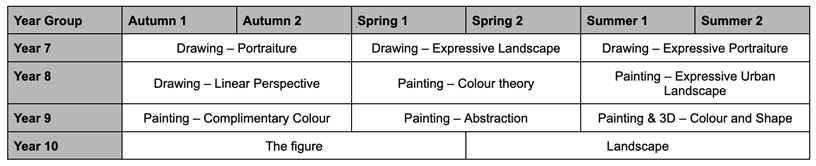
Curriculum Overview – Art
Computing
Curriculum Purpose
Preparing students for careers and furthering social justice
Computer Science is a modern, fascinating subject. The world depends on computers - In KS4 students learn about how computer programming can create solutions to everyday problems and future challenges. It can open up a whole world of opportunities.
Our curriculum and lessons will give students the opportunity to choose from a wide range of Computing careers e.g. Robotics Programmer, Games Developer, E-Commerce Manager, Cyber Protection Officer, Social Media Manager and many more. To do this, our students will achieve a P8 score of +1. A thorough academic science education will also provide a strong foundation that will benefit students to interact academically with peers, within computer science and other professional roles.
The purpose of the computer science curriculum is to provide students with a strong understanding of how the technology that surrounds them actually works, and in addition, equips them with the knowledge that will allow them to adapt to the constant technological changes that will inevitably occur during their lifetimes.
Knowledge acquisition as a measure of progress
Our curriculum and lessons will give students the knowledge (core, procedural and hinterland) to critically synthesise and analyse matters that involve computer science.
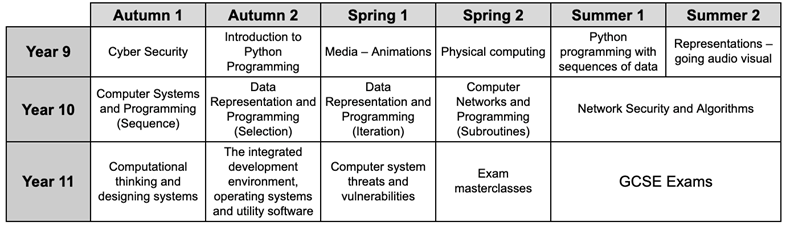
At GCSE, students follow the OCR Computing for GCSE Course. In Year 10 they gain an overview of computer systems and data representation and then Computer networks and network security. In year 11, students learn about specific search and sorting algorithms, also some software development concepts which include IDEs, debugging, and testing.
The needs of our community
Our curriculum and lessons will reflect positively the community of students within our school and actively question inequalities in computer science.
Teaching Computer science for its intrinsic value
We believe that the world is an amazing place. Computer Science helps us understand just how amazing it is. Our curriculum and lessons will give students the knowledge that will amaze, solve problems and develop a healthy scepticism.
Curriculum Rationale
What do we teach and why do we teach it?
Computer science, at its core, is about solving problems. Some of these problems are currently unknown and future careers are yet to be defined, whilst others are well established and require high levels of expertise. Companies specialising in communication, space science, aerospace and defence, many of which are in and around Bristol, require and rely on billions of lines of code that are developed by highly skilled practitioners. By teaching computing we are offering these opportunities to our local community.
At Trinity, computing is taught through three key strands – hardware (the arrangement of electronic components, information storage and processing), networks (the ways computer systems communicate with one another in increasingly flexible ways) and programming (the coding of software).
Why do we teach it in that order?
During year 9, students are introduced to the three strands with an emphasis on coding to instruct computers. At GCSE, the course has two parallel teaching streams: (1) Hardware and Networks and (2) Programming. Programming in particular requires problem solving skills that must have secure, flexible and background knowledge. Learning episodes are constructed that interleave abstract and concrete concepts. This means that knowledge is acquired with the flexibility that makes a good problem solver. Contextual and conceptual variation, together with the explicit teaching of critical analysis and deeper thinking allows students to develop these skills.
Curriculum Overview
Dance
Curriculum Purpose
Teaching Dance for its intrinsic value
Dance is a unique and joyful subject to study; it allows students to explore and develop their creative, physical, emotional and intellectual capacities as one.
The curriculum at Trinity is designed so that students gain knowledge within all these areas and build self confidence to experience the thrill of moving & performing.
We are all dancers
All humans move: dance is structured movement. Our curriculum will equip our students with the knowledge (tacit, procedural, declarative) within the core content of Dance: choreography, performance and critical appreciation.
The needs of our community
We will expose pupils to dance that builds and broadens their cultural capital including a wide range of professional works, modelling and performance opportunities.
Preparing for academic success
We will provide students with a solid knowledge base of choreography and performing enabling them to continue the academic study of dance into GCSE, A Level and beyond.
Curriculum Rationale
What is taught and why?
Dance is a subject that gives students the opportunity to develop their creative, imaginative, physical, emotional and intellectual capacities. Students do this by focusing on three areas: Choreography, performance and critical appreciation of dance.
Choreography is the skill of combining movements into phrases and/or dances to be performed. Students study and experience the key elements that make up choreography: the actions, dynamics, space and relationships of the dancers in relation to a theme or dance idea. It allows students to articulate themselves in a nonverbal way, access creative parts of the brain and develop soft skills including leadership and team work.
We teach students performance knowledge so they experience the joy of performing. These are divided into a series of skills: physical, technical, expressive and mental skills. All students are expected to perform in a class situation and are given the opportunity to perform within and beyond the school.
Critical appreciation of dance is the ability to describe and evaluate dance. This includes their own work, the work of others and professional dance works. Students learn how to gain this knowledge through oracy and written work which increases in difficulty across the year groups.
Why is it taught in that sequence?
Each core content is taught within every scheme of work, although our termly assessments have a focus upon just one of them.
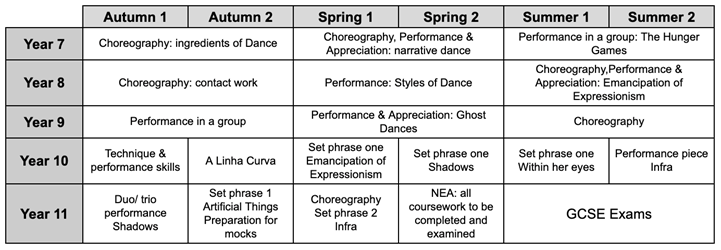
As students progress through the school, the knowledge they are required to learn increases in intensity and difficulty. For example a taught phrase in Year 7 will be shorter and contain movements that are simpler than a phrase taught in Year 10 – the speed, use of levels, action content and coordination requirements are a small example of what may be different.
A choreography task in Year 9 will be more open and less directed than one in Year 8 as the students have prior knowledge of, for example, formations within the dance space.
Curriculum Overview
Design & Technology
Curriculum Purpose
Preparing students for careers and furthering social justice
Our curriculum and lessons will give students the opportunity to choose from a wide range of STEAM careers. To do this, our students will achieve a P8 score of +1. A thorough academic DT education will also provide the knowledge and skills to allow students to be problem solvers, creative designers and skilful manufacturers, within DT and other professional roles.
Knowledge acquisition as a measure of progress
We believe we should encourage children to use their creativity and imagination, to design and make products that solve real and relevant problems within a variety of contexts, considering their own and others’ needs, wants and values. We aim to, wherever possible, link work to other disciplines such as mathematics, science, computing and art. Students are also given opportunities to reflect upon and evaluate past and present design technology, its uses and its effectiveness and are encouraged to become innovators and risk-takers.
The needs of our community
Cultural capital is explored across the key stages by appreciation of the work of others locally, nationally and internationally. Each subject identifies and relates projects and content to real contextual challenges focussing upon people, communities or businesses, with a particular focus on the local area that surrounds Trinity Academy.
Teaching DT for its intrinsic value
We believe that the DT is an inspiring, rigorous and practical subject which prepares all young people to live and work in the designed and made world. Our curriculum and lessons will give students the skills and knowledge that will ignite imagination, solve real life problems and develop an awareness of the current issues designers face in modern society.
Curriculum Rationale
What is taught and why?
Design and Technology gives students the opportunity to problem solve, learn the skills to process raw materials to manufactured products and to develop social, environmental and aesthetic awareness. Much of the content of the subject is explored through project work, with students following a design process. This process can be broadly summarised as a sequence of steps: researching, designing, manufacturing and evaluating (although often when engaged in a project these steps may not be so sequential, for example with students returning to the research phase when an error is spotted in the design phase). Within each project, students regularly encounter big ideas, or ‘threshold concepts’. These include key skills (equipment, tools and processes), social, moral and environmental issues, materials and their working properties, new and emerging technologies and health and safety.
The curriculum has been designed as appropriately sequenced projects with sufficient time for their full completion. Often in lessons key skills or procedures are modelled in a demonstration (what we call an ‘I do’) before students attempt it (what we call a ‘you do’). These two aspects (time and demonstration) allow students to physically produce high-quality manufactured products from raw materials.
Why is it taught in that sequence?
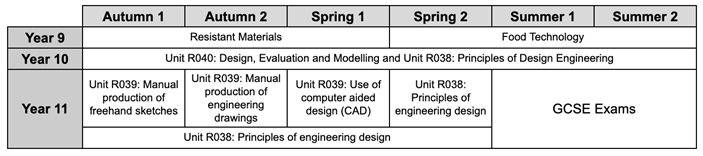
Students start Design and Technology in Year 9. They are first introduced to key aspects of health and safety before beginning practical work. Students then move onto projects based around woodwork skills (in particular marking out, cutting, shaping and finishing) and are then introduced to key design skills of technical drawing and then 3D modelling using CAD. For those students taking the subject to GCSE, two large project-based pieces of coursework (directed by the exam board) are completed alongside appropriate theory lessons.
Curriculum Overview
Drama
Curriculum Purpose
Teaching drama for its intrinsic value
Drama is a powerful tool that has for centuries communicated entertaining stories and challenging messages across the world. Through drama we want every student to feel inspired to express the world around them with confidence and creativity.
We are all subject experts
Our approach to curriculum will equip our students with the knowledge (Tacit, Procedural, Declarative) across a range of playtexts and styles of theatre making to critically engage in creating, performing and responding.
The needs of our community
We will expose students to a range of contexts and themes that broaden their cultural capital, providing examples and modelling to ensure access for all.
Preparing for success
We will provide pupils with a solid foundation in acting and design, developing their oracy
to equip them for further study in the subject and prepare them for work in creative industries. This will be supported by our wide range of performance opportunities and links with the Bristol Theatre Community.
Curriculum Rationale
What do we teach and why do we teach it?
Drama gives students the opportunity to work in groups and discuss, rehearse and perform many different playtexts. We have chosen to focus on at least two key playtexts in each year group so that students are exposed to a variety of high quality examples of theatre practice. This in turn broadens students' knowledge of what theatre looks like and how they might like to express themselves. They then use this knowledge of the playtexts, including characters, plot, themes and style, to create and perform their own pieces, learning to express themselves.
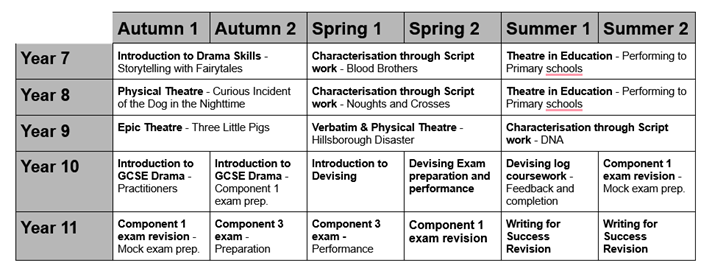
We have chosen to focus Year 7 on key vocal and physical performance skills that will be needed throughout their studies in Drama, and essential to creating convincing and confident performances. Unlike many schools we have then decided to explore design roles in the theatre and different styles of performance in Year 8 and 9 as we want to broaden pupils’ knowledge of creative industries and the world of theatre. As the curriculum progresses into Phase 2, students use their knowledge of playtexts, styles and performance techniques to make informed decisions, thinking critically about their intent for communicating to an audience.
Why do we teach it in that order?
The drama department has built a ‘spiral’ curriculum that visits new knowledge and performance skills throughout the Autumn and Spring terms. These skills are then revisited in the Summer terms in a new context to reinforce and apply learning. The complexity of learning increases throughout Phase 1 and 2 through combining different performance skills with a clear intention to create meaning to the audience. Pupils learn to describe, explain, analyse and evaluate work throughout their curriculum journey, so that when they leave Trinity they can reflect on their own work and the impact it can have on others.
Curriculum Overview
English
Curriculum Purpose
Preparing students for life after school
At Trinity, part of our mission is to ensure that all students will ultimately be successfully and happily employed in a career with prospects, and we know that the better they’re able to read, write, speak, and listen, the more successful they’ll be.
Using knowledge acquisition as a measure of progress
While reading, writing, speaking, and listening may sound like simple skills, they’re actually very complex in the sense that they rely on a huge amount of background knowledge - whether that’s of letter sounds, word meanings, syntactical rules, or knowledge of text conventions and/or specific topics.
By assessing students on entry, we’re able to identify the knowledge gaps that may hold them back, and work out how best to close them; and by designing a spiral curriculum that revisits key historical periods and key literary genres each year, we’re able to broaden and deepen their knowledge throughout their time at the school.
Meeting the needs of our community
In a school like ours, which serves students from a range of social, economic, and cultural backgrounds, it’s vital that everyone feels seen, supported, and stretched in every subject.
In recent years, there’s been a big effort nationally to review and diversify the English canon, and at Trinity we’ve leant into that by ensuring that our curriculum features a range of texts by a range of authors from a range of different backgrounds, some of whom are local to Bristol.
That said, we don’t want to disadvantage our students by denying them the kind of cultural capital that has traditionally been taught in the independent sector, and that is still valued by Russell Group universities, including Oxford and Cambridge. For that reason, our choice of texts is also highly academic.
Teaching English for its intrinsic value
While part of our mission is to ensure that our students are ultimately employed in careers with prospects, we also set out to ensure that they’re becoming the best versions of themselves in terms of their heads, their hearts, and their souls.
And as an English team, we believe that our subject is uniquely placed to develop all three, in the sense that it’s academically challenging, emotionally enriching, and ultimately life-enhancing to engage with the stories of others, and to learn to tell our own.
Curriculum Rationale
What do we teach and why do we teach it?
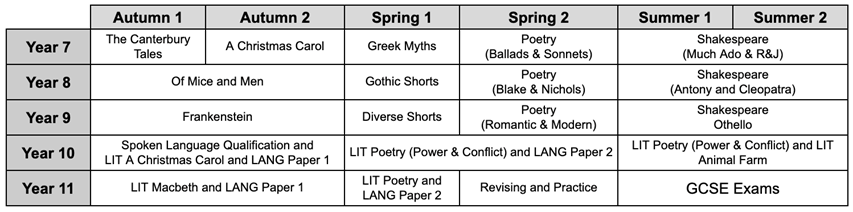
In line with the National Curriculum for English, the Trinity curriculum covers a variety of plays by Shakespeare (including Much Ado About Nothing, Romeo and Juliet, Antony and Cleopatra, Othello and Macbeth), as well as a range of fiction and non-fiction texts from other genres, periods and parts of the world. Our choice of texts is driven by two key considerations. Firstly, which texts best enable students to explore and discuss different aspects of the human condition. For this reason we draw largely from the traditional canon - Shakespeare, Blake, Shelley etc - as these texts have stood the test of time when it comes to providing a lens into human emotion and behaviour. Our second key consideration is which texts will most meaningfully reflect our particular cohort of children. For this reason our students are exposed to texts by authors of varying gender, ethnicity and world view.
These texts are used as a vehicle to teach our students to comprehend and then to form and express opinions about the things they read. Verbal and written communication are central to the design of our curriculum, whether analytical or creative.
Why do we teach it in that order?
Our curriculum is organised first by genre, meaning Year 7 students will encounter the short story, novel, poetry, drama and non-fiction in their first year at Trinity. The focus of this year is primarily creative writing to build directly on the work done at KS2, while the focus of Year 8 is primarily analytical writing, with the two being combined in Years 9 to 11. Each year the six genres above are revisited, but in a different period and through an increasingly challenging lens. For instance, Year 7 students will study A Christmas Carol (a Victorian novel) and use this to develop the way they write description and dialogue. By Year 8, students will be studying Of Mice and Men (a Modern novel) and learning how to construct arguments and link the techniques used by the author to the intentions and context of the text.
Curriculum Overview – English
Food Technology
Curriculum Purpose
Preparing students for careers and furthering social justice
Our Food and Nutrition curriculum and lessons at Trinity will give students the opportunity to choose from a wide range of careers in Food Science and Technology, Nutrition and Health Care, and of course, the Hospitality and Catering industry. To do this, our students will achieve a P8 score of +1. A thorough academic education in Food Preparation and Nutrition will also provide the knowledge and skills that allow students to prepare and make a variety of healthy dishes alongside making wise dietary decisions and lifestyle choices.
Knowledge acquisition as a measure of progress
The Food department at Trinity Academy realises that food nutrition is essential for the mental and physical development of children. Nutrition education underpins improving nutritional status, and provides pupils with the knowledge, skills and motivation to make important dietary decisions and lifestyle choices. Understanding and improving the landscape of nutrition and support for children is therefore of high importance to Trinity School. As a centre of education we are the perfect platform to address issues related to food, diet, nutrition and health, as well as environmental issues, providing an evidential counterpoint to the ever changing sea of food related influences that confuse at best.
The needs of our community
Cultural capital is explored across the key stages by appreciation of the work of others locally, nationally and internationally. Each subject identifies and relates projects and content to real contextual challenges focusing upon people, communities or businesses, with a particular focus on the local area that surrounds Trinity Academy.
Teaching Food and Nutrition for its intrinsic value
We believe that Food and Nutrition is an inspiring, scientifically rigorous and practical subject which prepares all young people to live a healthy lifestyle and make informed dietary decisions that change lives.
Curriculum Rationale
What do we teach and why do we teach it?
The Food Preparation and Nutrition curriculum provides students with the knowledge, skills, and understanding to make informed choices about food and to lead healthy and fulfilling lives. We aim to develop students' practical cooking skills and promote a love for cooking. Our intent is to ensure that all students acquire the necessary knowledge to make informed decisions about the food they consume, becoming confident and competent chefs who can contribute positively to their own well-being and that of others.
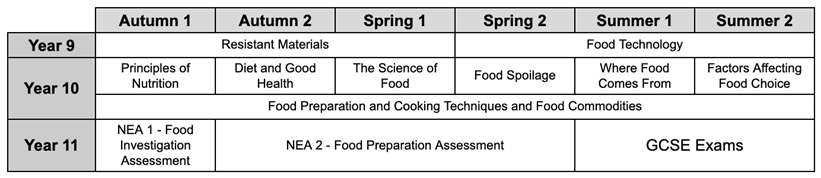
We have developed a curriculum that is based on the national curriculum and the demands of our KS4 course. Our curriculum is structured to provide a progression of skills and knowledge throughout Year 9 and Key Stages 4, building upon prior learning.
We place a strong emphasis on practical cooking in all aspects of our curriculum. Students have regular opportunities to plan, prepare, cook, and present a wide variety of dishes. Practical lessons are supported by theoretical knowledge, ensuring students develop a well-rounded understanding of the science and nutrition of food.
Why do we teach it in that order?
Students start Food and Nutrition as part of the Technology curriculum in Year 9. They are first introduced to key aspects of health and safety before beginning practical work. Students then carry out practical cooking lessons where they learn how to weigh and measure accurately, safe knife skills and safe use of the oven and hob. Students are then introduced to a range of practicals that build on the skills learnt. Over the course, the meals produced increase in complexity, requiring greater combinations of practical skills and commodities. In theory lessons, students are taught the four C’s (cleaning, cooking, chilling and cross contamination) and the principles of the Eatwell guide. For those students taking the subject to GCSE, two non-exam assessments (NEA’s) are completed alongside appropriate theory lessons, carefully selected practicals and exam preparation.
Curriculum Overview
French & Spanish
Curriculum Purpose
Knowledge acquisition as a measure of progress
To ensure that Languages are a ‘subject for all’ – where all students can access an ambitious and academic Languages curriculum, achieve well and feel included in language lessons. Above average numbers of students will opt to study languages beyond the compulsory years and achieve +1 outcomes.
Preparing students for careers and furthering social justice
To develop students’ confidence in a range of transferable skills such as communicating, listening, translating/ interpreting and understanding in order to provide them with skills that will help them be successful in any professional field.
The needs of our community
To develop students who have an understanding of different cultures (both locally and globally) and to foster an open mind for a global community.
Teaching languages for its intrinsic value
Language learning is exciting and life-changing. Our Language teachers have lived and worked in a range of countries around the world and share their passion and knowledge of languages and the globe with our students.
Curriculum Rationale
What do we teach and why do we teach it?
Not only does studying a language help students to communicate with people from other countries and backgrounds, it can act as a window into different cultures and foster an openness to the practices of other communities. This feels particularly important for, and reflective of, our very diverse school community. Studying a language also develops important transferable skills – effective communication, listening and interpreting – that are valued by all professional fields.
The languages department breaks up content into four key areas of knowledge – the substantive (such as phonemes and key vocabulary), the procedural (such as sentence construction and grammar), the disciplinary (the ‘productive’ skills i.e. writing/speaking and ‘receptive’ skills i.e. listening/speaking) and the hinterland (the culturally rich aspects of learning another language). This knowledge is intertwined within each topic and, as with many other hierarchical subjects, recurs frequently across topics across years. To support accessibility and clarity of content, students at Key Stage Three (Years 7 to 9) use sentence builders (structured vocabulary lists). As pupils move through the sequence of lessons within a topic, the scaffold of these sentence builders is slowly removed as they begin to produce language with more automaticity. Students often engage in choral repetition, chanting and reading aloud to support them to master the sounds of the language.
Why do we teach it in that order?
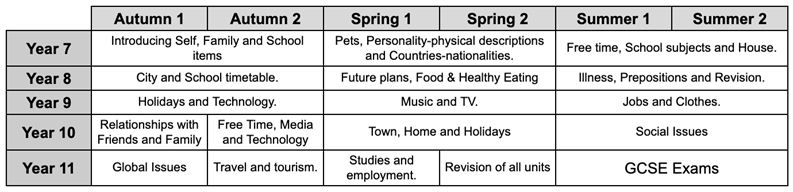
The languages department has structured their curriculum to become increasingly complex. In Year 7, students are introduced to topics that are more readily accessible. They learn how to talk about themselves and their family, about hobbies they enjoy and where they live. By the time they are in Year 9 the topics have shifted to the more complex and societal – including the environment, technology and about the Hispanic/Francophone world. This structure allows for a gradual building of more complex vocabulary and the skills needed to articulate ideas coherently.
Curriculum Overview
Geography
Curriculum Purpose
Preparing students for careers and furthering social justice
Our geography curriculum will enable our students to think geographically; we want our students to better understand the natural and social worlds, to think about alternative futures and what they could do to influence them in their personal and professional lives, to engage in current debates of geographical significance, to have power over their knowledge and go beyond the limits of their personal experiences and the geographical spaces they occupy.
Knowledge acquisition and application as a measure of progress
Our curriculum will give students the knowledge (powerful and procedural) to think geographically, engage with and critically analyse geographical issues.
The needs of our community
Geography is a powerful subject and we recognise the importance of representing the world accurately, fairly and truthfully. Our curriculum will reflect positively on the community of students within our school and actively question inequalities in our local and global environments.
Teaching geography for its intrinsic value
We believe the world is an amazing place and that the subject of geography is well placed to understand, discuss and solve many of society’s most pressing challenges.
Curriculum Rationale
What do we teach and why do we teach it?
Our approach to curriculum is underpinned by Lambert’s GeoCapabilities framework. Knowledge is broken down into substantive knowledge (the factual and contextual knowledge of Earth as a system), conceptual knowledge (in which students acquire the ability to develop inferential and relational knowledge about geographical concepts) and procedural knowledge (equipping students with skills to access and question knowledge).
Through this approach, we enable our students to ‘think geographically’. We want our students to better understand the natural and social worlds, to think about alternative futures and what they could do to influence them in their personal and professional lives,, to engage in current debates of geographical significance, and to have power over their knowledge and go beyond the limits of their personal experiences and geographical spaces.
Why do we teach it in that order?
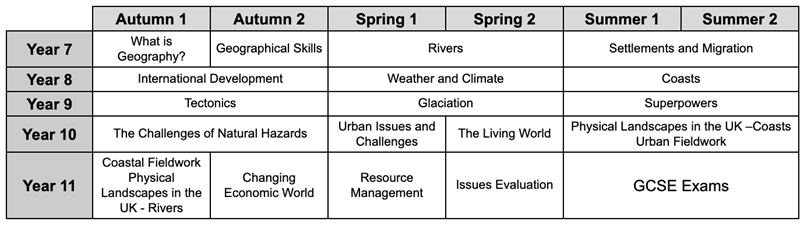
Our KS3 curriculum introduces a range of geographical concepts, such as place, space and human and physical processes through ‘familiar’ scenarios, and provides opportunities to acquire and practise procedural knowledge. The curriculum interweaves and revisits geographical concepts so our students are able to develop sound understanding and flexible thinking. Flexible thinking enables our students to apply their knowledge to increasingly unfamiliar and complex geographical scenarios and develop a geographical ‘state of mind’. For example, in Year 7, we introduce erosion as a physical process in the context of a fluvial environment. In Year 8, students apply their understanding of erosion to coastal environments and develop inferential knowledge as they make links between erosion and tourism, and erosion and global warming.
Curriculum Overview
History
Curriculum Purpose
Preparing students for life after school
Our curriculum and lessons will allow students to become historically informed critical thinkers, who can analyse information, question, reason and communicate effectively, thereby supporting success across a wide range of careers. To do this, our students will achieve a P8 score of +1.
A thorough academic History education will equip pupils with knowledge which allows them to interact academically with others engaged in the study of the past; it will also allow them to better understand the concerns and priorities of a wide range of people, navigating the modern world with confidence and success. Above all our curriculum will instil in our pupils a love for historical study while supporting the development of intellectually curious minds which are accustomed to questioning evidence and probing assumptions.
Knowledge acquisition as a measure of progress
Our curriculum and lessons will give students the knowledge to understand, analyse, evaluate and critically synthesise information relating to history.
The needs of our community
Our curriculum and lessons will support the community of students within our school and actively challenge inequalities, both by exploring historical injustices and by examining the experiences of previously marginalised groups. Pupils at Trinity Academy will experience a History curriculum which not only explores the lives and actions of traditional elites but also examines the experiences of Black and Minority Ethnic Groups, women, the working classes and the LGBT+ community. This will be achieved through dedicated lessons and topics within the curriculum and through wider school events.
Teaching History for its intrinsic value
We believe that the world is an amazing place and that the study of History shows us how amazing it is. Our curriculum and lessons will introduce students to a wide range of human achievements and follies, helping them to appreciate the richness of the human experience and to guard against the misuse and distortion of History for the furtherance of destructive objectives. Our curriculum will develop in all students a rich insight into the past which will allow them to understand their own ideas and experiences within the contexts of local, nation and international developments, both distant and more recent.
Curriculum Rationale
What do we teach and why do we teach it?
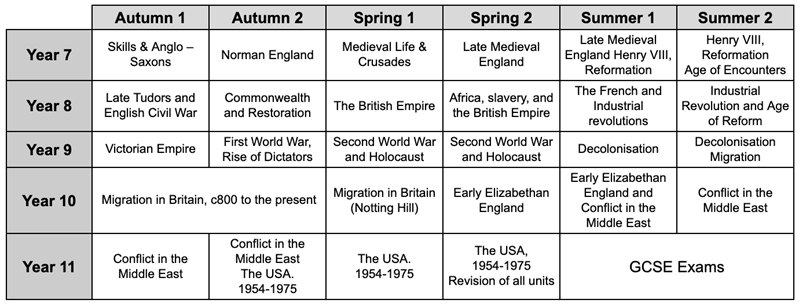
The selection of topics in history is naturally quite contentious, not least because there is so much to choose from. We have made the decision to teach topics that enable students to construct a narrative history of Britain and its relationship with the wider world while learning about causation, change and continuity, chronology, evidence, interpretation and significance. We also deepen their understanding of key substantive concepts, particularly the changing nature of government, religion and religious conflict, imperialism and the struggle for rights and freedoms. These concepts are the through lines that connect our topics together as we move from medieval to modern history. We also try to ensure that our topics provide representation for our cohort. Our aim is that when students encounter another culture in history, this is never solely through the lens of persecution or conflict but also includes a celebration of other cultures.
Why do we teach it in that order?
To some extent the sequencing is done for us in history in that we teach chronologically. However, we have also sequenced our key substantive concepts (described above) through the curriculum. Each time we revisit one of these concepts, we draw explicit links back to previous encounters we have had with them and we delve into more complex aspects of those concepts. So for instance, we teach students about systems of government through the feudal system in Year 7 and then revisit it in a much more sophisticated way when we introduce parliamentary democracy in Year 8, moving onto conflicting political ideologies and totalitarian dictatorships in Year 9.
Curriculum Overview
Maths
Curriculum Purpose
Preparing students for life after school
Our curriculum will give students the opportunity to be successful in their chosen career (including giving them the opportunity to choose a career path within STEM). Our students will achieve a P8 score of +1. Students will use their strong mathematical knowledge to make informed decisions within their lives. We know this is vital as “good numeracy is the best protection against unemployment, low wages and poor health” (McCrea, 2013).
Knowledge acquisition as a measure of progress
Students will be given the knowledge (declarative, procedural, conditional and maths for communication) to build a strong understanding of important mathematical concepts. Maths for communication (particularly the meaning of key words) is a vital part of mathematics and must be explicitly taught. The methods we teach should be consistent across the department and future facing (‘teach it right first time’ and ‘never teach anything you’ll need to unteach’).
The needs of our community
Teachers are aware that maths is often associated with anxiety and challenge the misconception that maths is a subject in which you are either right or wrong. Students know that everyone can be successful at maths and always know how they can improve.
Teaching maths for its intrinsic value
We believe that the world is an amazing place and that the study of maths shows us how amazing it is. Students should be given the opportunity to see the beauty and wonder of maths and in particular how different area of maths link (rather than seeing them as a list of distinct topics).
Curriculum Rationale
What do we teach and why do we teach it?
We believe that it is vital that all students leave Trinity Academy with a strong understanding of important mathematical concepts along with excellent numeracy skills. Strong mathematical knowledge supports students to be successful in their chosen career and in making informed decisions within their lives. This is particularly important as “good numeracy is the best protection against unemployment, low wages and poor health” (McCrea, 2013).
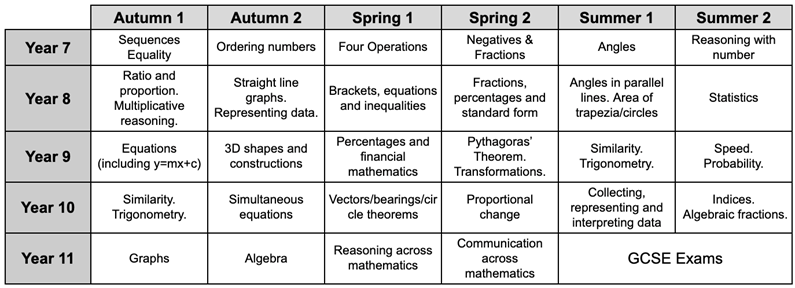
The maths department breaks up the mathematical concepts and skills into four types of knowledge – declarative (“I know that…”), procedural (“I know how…”), conditional (“I know when…”) and knowledge for communication. These types of knowledge form the basis of the main topics of number, algebra, ratio and proportion, geometry, statistics and probability. These topics recur as students move up the years and gradually build in complexity and intricacy.
Why do we teach it in that order?
Whilst the selection of maths knowledge is relatively uncontentious, the order in which it is taught can be. Students first learn about algebra as this will be a relatively new concept to all students and can act as a ‘leveller’. It is also a topic that can be later included in all other topics. Students then begin to focus on key number concepts (such as place value, fractions and negative numbers) to develop a firm understanding before moving on to more conceptually challenging topics (such as geometry, probability and statistics). More broadly, in Phase One (Year 7 and 8) there is an emphasis on declarative and procedural knowledge acquisition, with an increasing emphasis on conditional knowledge only after students have mastered the basics.
Curriculum Overview – Maths
Click Here for GCSE Revision resources
Music
Curriculum Purpose
We are all musicians
We will equip our students with the knowledge (Tacit, Procedural, Declarative) to have lifelong confidence and ability to critically engage with music, whether that be performing, composing or listening.
The needs of our community
We will expose pupils to music and musical opportunities beyond their community, building their cultural capital, at the same time as equipping them with the tools to understand music more deeply within their community.
Preparing for academic success
We will provide pupils with a solid academic foundation to pursue the study of music to GCSE, A level, and careers beyond, should they wish to do so. This includes building a solid foundation in singing through KS3.
Teaching music for its intrinsic value
Music is an amazing subject to study, encompassing the buzz of performing, creative satisfaction of composing and the complex cognitive work in analysing. Our curriculum celebrates all of these elements, and provides our students with a platform to showcase their creativity, increase their self confidence and collaborate with others.
Curriculum Rationale
What do we teach and why do we teach it?
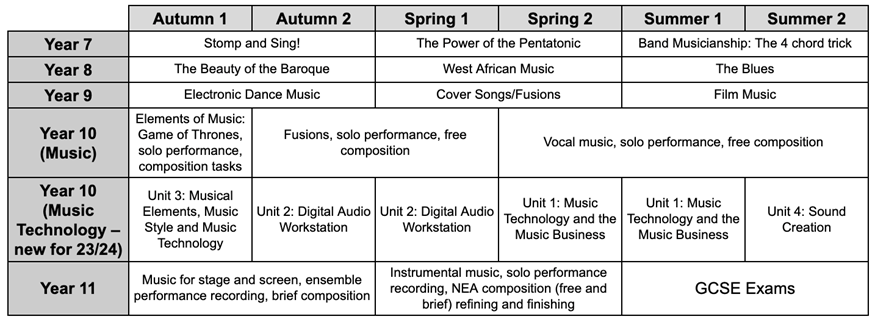
In line with the national curriculum for music, students learn to perform, compose, listen and analyse music of increasing complexity over their time at Trinity. They also gain a secure understanding of the elements of music through performing and composing music in a variety of genres and styles. When choosing what music to focus on, we have a number of considerations at play. We choose genres that give our students the best opportunity to practise and experience a particular concept (for example, 4 chord pop songs are a good way introduce triads and harmony), but also we have a duty to introduce our students to music beyond their normal experience (Baroque Music in Year 8, Fusions and Electronic Dance Music in Year 9). This balance is constantly reviewed and refined, as we also want to encourage students to listen critically, play, and respond to music that is around them.
In terms of performance, we focus primarily on singing and keyboard in Year 7 and 8, because we think these are the best instruments through which students can explore music and express themselves successfully, however we explore instruments such as the djembe and the ukulele in some units. We also encourage students to use their knowledge and skills from peripatetic instrumental lessons and to use their own instruments in the music classroom.
In terms of composition, we begin without instruments – using body percussion to compose. During Years 9 and 10, students use the keyboard to generate their ideas, and from Year 9, we introduce Music Technology as a means to organise and create a larger number of musical ideas. During the GCSE course, students are then encouraged to compose on the medium that suits them, whether that be technology, their instrument or voice.
Why do we teach it in that order?
The focus of Year 7 and 8 is to build a secure foundation in the understanding of music. This is done through a spiral curriculum, where we learn about the elements of music (ie. rhythm) both theoretically and practically, and these elements are revisited with increasing complexity and challenge. By the end of Year 7, students will have a secure understanding of how the musical elements work in isolation: how to play and construct rhythms, melodies and chords (harmony), and also a basic understanding of how to play the keyboard. This understanding is built on in Year 8, where musical elements are explored in conjunction with one another: students explore the interaction between melody and harmony and Baroque music, as well as rhythm and texture in West African Music. Generally speaking, throughout all phases, students explore music first through listening and performing it, and then deepen their understanding of it through creating music in that style.
From Year 9, students are able to compose more complete pieces of music with greater complexity and creativity. They move from group and paired composition tasks to individual composition tasks, and in years 10 and 11 they are encouraged to use their knowledge and skills more creatively, in having more freedom over what music they compose and how they do it. In terms of performance, students focus on accuracy and fluency as well as basic technique and later learn how to play and sing with increasing expression, and how they can make their own mark on the interpretation of a piece of music.
Curriculum Overview
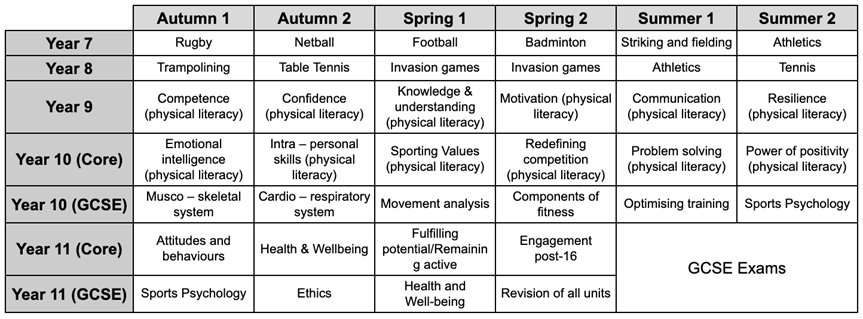
PE
Curriculum Purpose
Preparing students for careers and furthering social justice
Our curriculum and lessons will give students the opportunity to choose from a wide range of careers in all fields. This is because our Physical Education (PE) curriculum emphasises the transferable knowledge and skills.
Knowledge and skill acquisition as a measure of progress
Our curriculum and lessons will give students the knowledge of sporting fundamentals and of the science of the body, physical literacy and how to live a healthy life. As students move through the school they will be introduced to exciting sports and new forms of physical activity. They will develop ‘inter’ and ‘intra’-personal skills and unlock a sense of adventure and fulfilment from physical movement. All of which will allow our students to become healthy and active citizens.
The needs of our community
We emphasise the soft skills that underpin our subject that are transferable to all aspects of life to support pupils to achieve a career with prospects and to raise the employment rate in the local area. We place a huge emphasis on physical movement being an important part of leading a healthy lifestyle to increase the number of healthy citizens in the local area.
Teaching physical education for its lifelong value
We strive to make the students responsible, passionate and accountable for their health, fitness and wellbeing, whilst creating a passion and enjoyment for it to be a part of their daily lives, not just now, but in the future.
Curriculum Overview
PSCHE
Curriculum Purpose
Preparing students for life after school
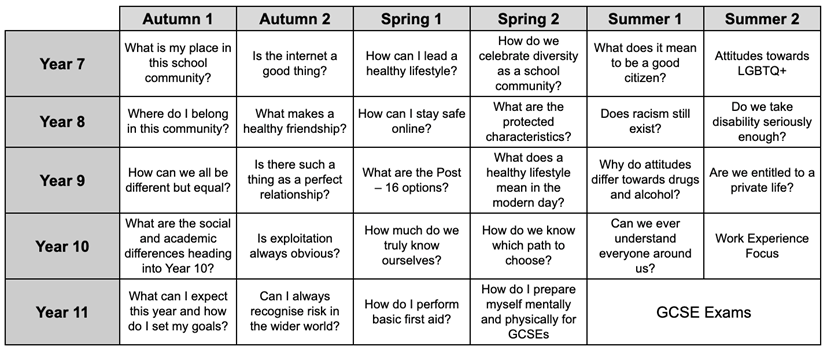
Our PSHCE curriculum will prepare students for life beyond school. This will be through a focus on careers and preparing them for the practicalities of life after school as well as preparing students to be able to engage articulately in discussion on a wide range of issues.
PSHCE is responsive to the needs of the year group
Our PSHCE curriculum will meet statutory requirements whilst being responsive to the pastoral and safeguarding needs of each phase. Phase Leaders are members of the safeguarding team which allows the curriculum to be responsive, iterative and proactive in terms of national themes.
The needs of our community
Our curriculum and lessons will support the community of students within our school and actively challenge inequalities through discussion of the protected characteristics. Each year group will consider at least one protected characteristic per year. This will be supported through Drop Down Days and wider events such as anti-bullying week and Black History Month.
Teaching PSHCE for its intrinsic value
We believe that pastoral learning is as important as academic learning. We believe that the pastoral curriculum equips young people to be citizens with a burning passion to serve their communities.
Curriculum Rationale
What do we teach and why do we teach it?
The selection of topics for PSHCE spans both statutory content and topics that are relevant to our community. As members of our safeguarding team oversee the curriculum, it reflects the issues that our students face during their school experience. We return to essential themes such as the protected characteristics, health, relationships and online safety throughout the curriculum. We deliver topics through teacher led sessions, a range of discussion based activities and considering real-life scenarios. We also have Drop Down Days that enable students to discuss and explore topics in more depth.
Why do we teach it in that order?
Students are introduced to topics across Phase One (Years 7 and 8) that they then return to in more depth in Phase Two (Years 9 and 10) and Phase Three (Year 11). For example, students are introduced to the idea of protected characteristics which they then return to across the curriculum. Topics such as consent and relationships are also introduced in an age appropriate manner in Phase One which are considered in more depth as students mature. We follow advice on age appropriate content from organisations such as The PSHCE Association and Split Banana. We respond to safeguarding logs to ensure we are tackling themes that are relevant to each year group.
Curriculum Overview
REP
Curriculum Purpose
Preparing students for life after school
The multi-faceted nature of REP means that students are prepared for life after school in a variety of ways. Viewing REP as a theological discipline, students become critically aware thinkers who are able to analyse information, understand its context, perform textual analysis and consider multiple interpretations from different perspectives. Students will also be able to understand the translation between a belief and a practice/action. In looking at REP from a philosophical and societal lens, students develop an appreciation for worldviews and consider other people’s experiences of the world, debating and arguing well. Empathy, compassion and oracy skills are developed here.
The importance of REP and its place in the modern world, with particular reference to Careers, is signposted. (For example, after the 2008 financial crash major banks explicitly focused on employing Theology graduates to inform the moral implications behind financial trading.) Understanding the routines and rationale behind different faiths makes for a more cohesive working environment in any Careers setting.
Knowledge acquisition as a measure of progress
Our curriculum and lessons will give students the knowledge to understand, analyse, evaluate and critically synthesise information relating to REP. A particular measure of successful knowledge acquisition is when students are able to compare, contrast and link theological concepts to modern-day practices, be it verbally or in written pieces.
The needs of our community
|
Community Need… |
Curriculum Response |
|---|---|
|
Teaching of REP at KS1 and KS2 is inconsistent - pupils are either taught by non-specialists or REP is sidelined for other subjects such as Maths and English. |
At KS3, we work on the basis of little-to-no prior knowledge. Lessons are low threshold, high ceiling and focus on exploring challenging concepts within familiar stories. |
|
The main belief groups in Lockleaze are Christian, Muslim and ‘Nones’. |
The KS3 curriculum begins with the Abrahamic Faiths to ground student understanding and reflect the majority beliefs. Different religions are introduced in order to give a broader understanding. |
|
Self-esteem and sense of belonging are important to foster in young people. |
The curriculum provides plenty of opportunity for debate, understanding self awareness and sharing views to build self-esteem and create a greater sense of self. |
|
Typically, students from Lockleaze are less likely to go on to higher education |
The REP curriculum covers disciplines which would be studied at a Russell Group university: Theology, Religion, Philosophy and Ethics. High level language is used through KS3-5, and degree-level ideas are introduced as hinterland knowledge. |
Teaching REP for its intrinsic value
We believe that the world is an amazing place, but that there are many sources in a young person’s life which may misrepresent people in the world. REP is intrinsically valuable at a societal and individual level. There is an inherent value in seeing and experiencing how other people view the world, in addition to unpicking dangerous stereotypes whilst helping to develop a student’s worldview. Whether religious or otherwise, no-one can deny the impact religious ideas have had, and continue to have, on the world. It is important that, as a people, we see value in understanding this.
Curriculum Rationale
What do we teach and why do we teach it?
We believe that REP should equip students with a sound understanding of the origins, as well as the core stories, beliefs and practices of major world religions. This is in order that they can recognise the influence of religion on modern culture and values and become increasingly curious about, and accepting of, other world views. This feels particularly important in our religiously diverse community. We feel strongly that a grasp of Biblical stories is important both for understanding the Abrahamic faiths and for appreciating important aspects of world culture. For this reason, we begin with Biblical Literacy, studying the major stories of the Old and New testaments. Thereafter, we spend Years 7 and 8 teaching the history, beliefs and practices of Christianity, Judaism and Islam. Students are then given the opportunity to apply their understanding of these different world views to interesting ethical challenges in Year 9, before moving onto Hinduism, Buddhism and the non-religious worldview, Humanism.
Why do we teach it in that order?
We begin REP in Year 7 by studying Judeo-Christian stories from the Old Testament. This is for three central reasons. Firstly, because these stories form the basis of both Christianity and Judaism and are therefore a logical chronological starting point. Second, because many of these stories are also shared across the three major Abrahamic faiths and we want to highlight the common ground between these religions before highlighting the differences. Thirdly, these stories provide a useful means by which to begin exploring the concept of interpretation which is key to understanding much of the divergence between and within religions. The decision to teach philosophy and ethics in Year 9 reflects the more cognitively demanding nature of this material. Similarly, Hinduism and Buddhism are more complex than the straightforwardly monotheistic Abrahamic faiths studied earlier in the curriculum. By the summer term of Year 9, students will have drawn comparisons and contrasts between the major world religions and in doing so, will have been continually developing their understanding of what constitutes a religious worldview. This means students are sufficiently equipped by this point to explore the key elements of the non-religious worldview of Humanism and think critically about how this compares to a religious worldview.
(A note on apportioning curriculum time in REP: We have made the decision to apportion the most significant amount of curriculum time to studying Judaism and Islam. This reflects the fact that (a) Judaism is the least well represented of the major religions amongst our cohort and therefore the least well understood and (b) that a significant proportion of our students are Muslim and therefore a shared understanding of this religion is important in helping build an inclusive community.)
Curriculum Overview – REP

Science
Preparing students for careers and furthering social justice
Our curriculum and lessons will give students the opportunity to choose from a wide range of STEAM careers. To do this, our students will achieve a P8 score of +1. A thorough academic science education will also give the powerful knowledge to allow students to interact academically with peers, within science and other professional roles.
Knowledge acquisition as a measure of progress
Our curriculum and lessons will give students the knowledge (core, procedural and hinterland) to critically synthesise and analyse matters that involve science.
The needs of our community
Our curriculum and lessons will reflect positively the community of students within our school and actively question inequalities in science.
Teaching science for its intrinsic value
We believe that the world is an amazing place. Science helps us understand just how amazing it is. Our curriculum and lessons will give students the knowledge that will amaze, solve problems and develop a healthy scepticism.
Curriculum Rationale
What do we teach and why do we teach it?
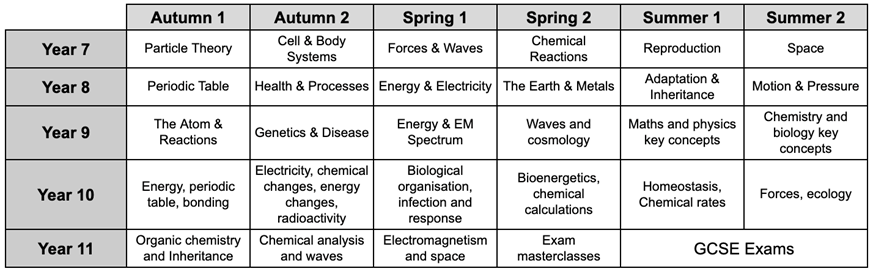
We believe that having a thorough understanding of scientific concepts is vital for students to engage productively with the world. Not only does it equip students with powerful knowledge and open up a vast array of careers, it also develops problem solving and a healthy scepticism. Knowledge is broken down into core substantive knowledge (key facts and definitions), procedural knowledge (‘how to…’ such as mathematical procedures and practical methodologies) and hinterland knowledge (the narrative or stories that enrich our understanding of science). Underpinning all of this, are key concepts – scientific models and ideas that are both fundamental and profound to access much of the scientific curriculum. Examples of key concepts include the cell, photosynthesis, respiration, the atom, chemical equations, electronic structures, energy, charge, the particle model of matter and forces.
Why do we teach it in that order?
At Trinity the disciplines of biology, chemistry and physics are taught in discrete topics, with students moving from one discipline to another throughout the year. The explicit teaching of key concepts is prioritised in Year 7 and 8 with students learning about cells, particle theory and forces early on. As students move through the years, and as topics become more complex, relevant key concepts are revisited to support the introduction of conceptually challenging material. For example, before teaching about collision theory and enzyme action, students are reminded about the particle model and its implications.
Curriculum Overview
GCSE Information
Every student in Year 10 and 11 will study a core set of subjects that will prepare them for either five or six GCSE qualifications – English language, English literature, maths and science (worth either two or three GCSEs). Students will then be able to choose four subjects from a range of fourteen choices (one has to be either Geography or History). To find out more about the GCSEs that are available and details of each course, click on the link below.
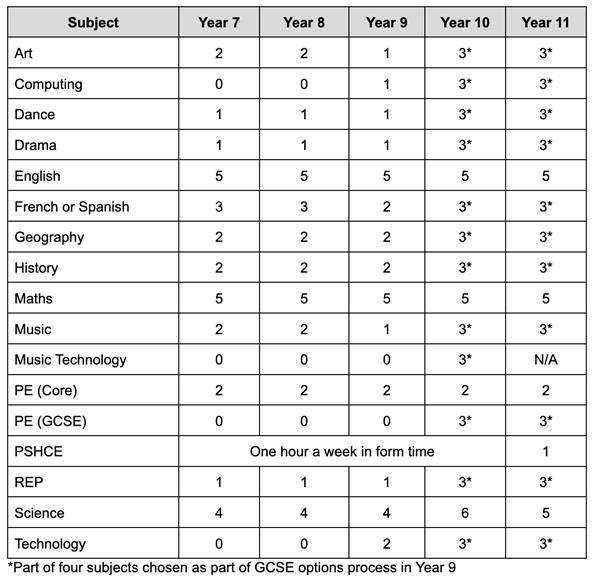
Number of Lessons Taught Per Subject, Per Week
The table below shows the number of 50-minute periods each subject is taught across the week.
School Contact
If you would like to find out more about the school curriculum, please contact our Deputy Headteacher Mr Joel Brisk using the email address jbrisk@trinityacademybristol.org.